Next Tuesday, Malawians are set to vote for the next leader, following a turbulent five years involving economic turmoil, natural disasters and the shock death of Vice-President Saulos Chilima in a plane crash last year.
Incumbent President Lazarus Chakwera is vying for a second term, his predecessor-turned-archrival being Peter Mutharika, an octogenarian Chakwera defeated in the court-ordered fresh presidential election of June 2020.

Transparency and fairness are key talking points ahead of the vote, given that the result of Malawi’s 2019 presidential election was overturned in the courts due to widespread irregularities judges termed irredeemable.
Among the 17 hopefuls there are two clear front-runners. Chakwera and Mutharika will square off against each other at the polls for the fourth time—though the third time ended up not counting.
Mutharika first defeated Chakwera in 2014, but when he was declared winner over Chakwera of Malawi Congress Party (MCP) in the next election in 2019 the result was annulled. Chakwera won the re-run the following year.
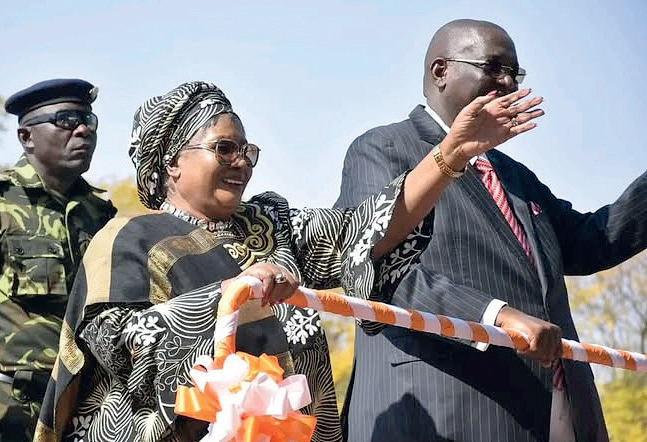
Chakwera-MCP
The former theology lecturer and preacher, had no political experience when he emerged as leader of the MCP in 2013.
When the former opposition leader ran for president in 2014 he was unsuccessful, but in 2020 he triumphed, beating the incumbent, Mutharika, in that unprecedented re-run.
Chakwera’s time in office has been marred by economic turmoil and allegations of corruption.
The 70-year-old sitting president did, however, reintroduce train services in Malawi for the first time in over three decades. He has also overseen major road construction across the country.
Mutharika-DPP
The 85-year-old lawyer and law lecturer, who led Malawi from 2014 to 2020,
is the brother of the late president Bingu wa Mutharika, who died in office in 2012.
Like Chakwera, Mutharika is also burdened by corruption allegations and links to economic crises.

However, his supporters would argue that the current high inflation rate (around 27 percent) is proof that Mutharika managed the economy better than his successor.
Mutharika’s age may count against him in this election. Speculation about his health is rife, especially as he has rarely been seen out in public during the campaign period.
However, the former president promises a return of proven leadership and opinion polls point to his possible victory.
Other contenders garnering attention are former president Joyce Banda of People’s Party, current Vice-President Michael Usi of Odya Zake Alibe Mlandu and former reserve bank governor Dalitso Kabambe of UTM Party.
What are the key issues for voters?
The economy
The past few years have been especially punishing for Malawians, with over a quarter living below the international poverty line.
The country was devastated by Cyclone Freddy that killed hundreds of people in 2023, then a drought swept across southern Africa the following year. Food prices skyrocketed due to a short supply of crops, pushing many Malawians into extreme poverty.
Economists also put Malawi’s current inflation problems partly down to the shortage of foreign currencies—known as forex—in the banks.
In addition, Malawi has been forced to devalue its currency and was recently crippled by fuel shortages and nationwide power outages.
Corruption: When Chakwera came to power, he vowed to “to clear the rubble of corruption” that has long plagued Malawian politics. His administration says it has excelled in this area, but critics, including the influential Catholic bishops, say this is not the case.
Scepticism was sparked last year when the director of public prosecutions dropped corruption charges against high-profile figures.
Additionally, the Anti-Corruption Bureau (ACB), has been without a director since former boss Martha Chizuma left more than a year ago.
To some, the failure to appoint a new head actively hinders the fight against corruption.
But previous administrations have also been dogged by graft allegations. For instance, the ACB accused Mutharika of receiving a kickback from a contract to supply food to the police. He denied any wrongdoing.
Banda’s reputation was dented by a scandal dubbed “cashgate” which happened under her watch. She was cleared by the ACB of any wrongdoing.
Chilima’s death
On June 10 last year, Vice-President Chilima and eight others died in a plane crash. Popular with the youth, Chilima led the UTM party and could have been a key contender in the upcoming elections, especially as he had fallen out with the president.
Although two investigations—one carried out by Germany’s aviation accidents agency and another by a Malawi government-appointed commission—did not find evidence of foul play, some Malawians remain suspicious of the authorities.
Opposition parties have been fuelling this skepticism during their campaigns, referring to Chakwera’s party as the “Chikangawa Party” (Chikangawa Forest being the site of the plane crash).
What has happened in previous elections?
MCP governed Malawi from independence in 1964 until the country’s first multiparty poll in 1994.
Since the shift from a one-party state, the United Democratic Front, the DPP, the People’s Party and the MCP have all enjoyed stints in power.
Chakwera’s victory with the MCP in 2020 was one of the most significant moments in the country’s political history.
A general election had taken place the year before and Mutharika was declared the winner.
However, the Constitutional Court annulled Mutharika’s narrow re-election, saying there had been widespread tampering, including the use of Tipp-Ex correction fluid on results sheets.
Judges in the Constitutional Court ordered a re-run for 2020, and Chakwera won with 59 percent of the vote after having teamed up with Chilima.
Although Mutharika branded the re-run “unacceptable” and “a judicial coup”, the Constitutional Court was backed by the Supreme Court of Appeal and gained international acclaim for safeguarding democracy and refusing to be influenced by presidential power.
How 50%+1 works
Following the controversy of the 2019 election, Malawi implemented a new system, where a candidate must gain more than 50 percent of the valid votes to win the presidency in the first round.
There is a strong possibility that this year’s candidates will not reach this threshold in the initial poll, meaning a run-off election will have to be held within 60 days.
The MCP and DPP will likely try to bring other, smaller parties on board in order to secure a majority in the second round.
The outcome of the presidential election will be announced by the end of 24 September.
The parliamentary results will be announced by the end of 30 September.